









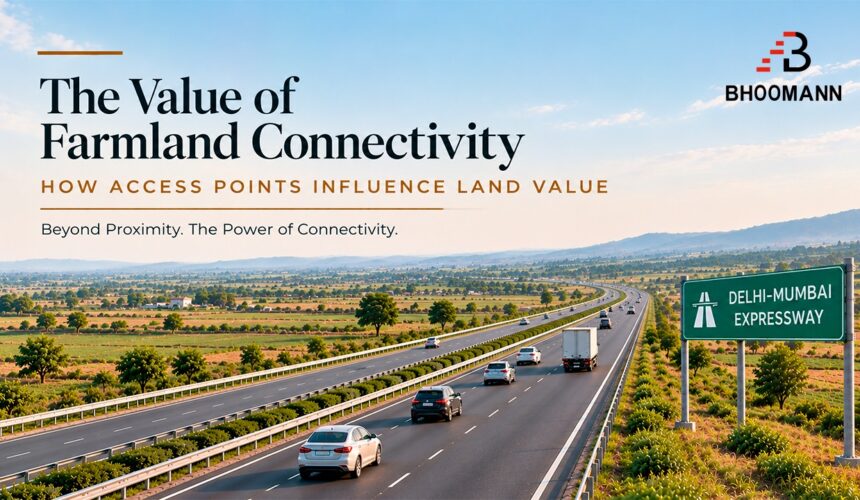
When evaluating farmland near the Delhi–Mumbai Expressway, the distance between a property and the highway is only part of the picture. The nearest usable entry or exit point, connecting roads, actual driving time, and local infrastructure can make a significant difference to how accessible and practical a land parcel is.
For buyers exploring farmland near Gurgaon, Naugaon in Rajasthan, or other countryside locations, understanding expressway connectivity is essential before making a purchase decision.
A property advertised as being close to the expressway may still require a lengthy drive to reach an operational interchange. Another Farmland located farther from the highway on a map may offer more convenient access through established roads.
This guide explains how expressway access points can influence farmland desirability, usability, and potential market value, along with the checks buyers should complete before purchasing.
Key Takeaways
- Expressway proximity does not automatically mean convenient access.
- Entry and exit points determine how vehicles can legally enter or leave an access-controlled expressway.
- The quality of connecting roads can matter as much as distance from the highway.
- Better accessibility may support buyer interest, but it does not guarantee land appreciation.
- Land title, permitted use, infrastructure, and total ownership costs remain essential considerations.
Understanding the Delhi–Mumbai Expressway and DMIC
The Delhi–Mumbai Expressway is a major road infrastructure project designed to improve connectivity between Delhi and Mumbai through an access-controlled highway network.
An access-controlled expressway differs from an ordinary road because vehicles cannot enter or exit at any convenient location. Access is provided through designated interchanges and connecting roads.
The Delhi–Mumbai Industrial Corridor (DMIC) is a separate industrial development programme. It is associated with industrial infrastructure and the Western Dedicated Freight Corridor rather than being another name for the expressway.
Buyers researching farmland should distinguish these projects when evaluating advertisements, infrastructure announcements, and future development claims.
For official information about the industrial corridor, consult the National Industrial Corridor Development Corporation.
For expressway-related planning, use current information from the National Highways Authority of India and relevant government agencies.
Why Expressway Access Points Matter for Farmland
An expressway can improve regional connectivity, but its benefits depend on how easily a property can reach it.
Imagine two farmland.
Farmland A is located close to the expressway boundary but requires a long drive along local roads to reach the nearest permitted entry point.
Farmland B is located farther from the expressway but connects to an operational interchange through a reliable, well-maintained road.
Although Farmland A appears closer on a map, Farmland B may offer a more convenient journey for regular visitors.
This distinction is especially relevant for people considering weekend properties, agricultural land, or farmhouse outside major cities.
Straight-Line Distance vs Actual Driving Distance
Straight-line distance measures the shortest distance between two locations on a map.
Actual driving distance follows the roads that vehicles are permitted to use.
For farmland near an access-controlled expressway, these measurements can differ substantially.
Before evaluating a Farmland, check:
- The nearest usable expressway interchange.
- The actual road distance from that interchange to the property.
- Whether the connecting road is public and legally accessible.
- Road conditions during different seasons.
- Any restrictions affecting the proposed route.
A short distance to the highway boundary is not enough to establish convenient connectivity.
How Expressway Connectivity Can Influence Land Value
Transport infrastructure can influence property demand by improving accessibility and connecting previously less-convenient locations with larger economic centres.
However, better road connectivity does not automatically translate into higher farmland prices.
Land value depends on several interacting factors.
1. Accessibility and Travel Convenience
For buyers living in Gurgaon or Delhi, travel convenience can influence how frequently they use a countryside property.
A location with practical access to major roads may be more appealing for weekend visits than one requiring difficult local travel.
This can influence buyer preferences, but the effect on market prices must be assessed using actual transactions rather than assumptions.
2. Quality of Local Infrastructure
Expressway connectivity cannot compensate for every infrastructure limitation.
Before purchasing, inspect the availability and condition of:
- Approach roads.
- Electricity connections.
- Water supply arrangements.
- Drainage.
- Mobile connectivity.
- Nearby essential services.
A property with dependable local infrastructure may be more practical than a farmland relying mainly on future development promises.
3. Legal Usability of the Land
Land-use permissions are critical.
Agricultural land does not automatically permit residential farmhouse construction, commercial accommodation, or resort development.
The applicable rules depend on land classification, local planning requirements, and approvals for the specific parcel.
Buyers should obtain written clarification and independent legal advice before assuming that a particular use is permitted.
4. Local Supply and Buyer Demand
Even where accessibility improves, land prices can be influenced by the availability of comparable farmlands, local demand, ownership restrictions, and broader market conditions.
A seller’s advertised asking price is not the same as a completed market transaction.
Buyers should examine comparable registered transactions where reliable information is available and consider differences in farmland size, access, title, and infrastructure.
5. Long-Term Development and Market Risk
Infrastructure announcements can attract attention, but proposed projects may be delayed, modified, or completed in stages.
Land values may rise, remain unchanged, or decline.
Resale can also take time, particularly where a property has limited permitted uses or unresolved documentation.
For these reasons, expressway connectivity should be treated as one factor in a wider property assessment rather than a guarantee of investment returns.
Farmland Near Gurgaon: What Buyers Should Evaluate
Many Delhi NCR buyers explore farmland near Gurgaon because they want countryside space without losing practical access to their primary residence.
However, a farmhouse near Gurgaon should be evaluated using actual travel routes rather than promotional distance claims.
Start by identifying your usual departure point. A journey beginning in central Gurgaon may differ from one beginning in Sohna or another part of NCR.
Next, compare the available routes to the property.
Consider:
- Access to major connecting roads.
- Operational expressway entry and exit points.
- Traffic near urban junctions.
- Local-road conditions.
- Availability of fuel stations and essential services.
- Journey reliability during weekends and holidays.
For a broader comparison of countryside locations, read our guide to the top locations to buy farmland near Gurgaon.
The goal is not simply to identify the shortest advertised journey. It is to understand whether the route is practical for the way you intend to use the land.
Farmland in Naugaon and the Delhi–Mumbai Expressway
Naugaon, in Rajasthan’s Alwar district, is among the locations considered by buyers exploring countryside land around the Delhi NCR region.
Interest in farmland in Naugaon is partly connected to its rural setting and its relationship with the wider expressway corridor.
However, the accessibility of an individual property depends on its exact location.
Two farmland marketed as Naugaon farmland may have very different approach roads, distances to an operational interchange, and access arrangements.
What to Check Before Choosing a Naugaon farmland
Before booking, request the property’s exact location and verify the driving route independently.
Check whether the proposed route uses existing public roads or depends on access arrangements that require clarification.
Visit the property and examine the condition of the final approach road.
Also confirm:
- The farmland boundaries.
- Ownership and title documents.
- Applicable land-use restrictions.
- Permitted construction, if any.
- Water and electricity arrangements.
- Maintenance responsibilities in gated communities.
- The status of proposed infrastructure.
Buyers considering farmland near Gurgaon should apply the same checks to any location marketed primarily on expressway proximity.
A Practical Comparison: Which Farmland Has Better Access?
Consider this hypothetical comparison.
| Factor | Farmland A | Farmland B |
| Distance from expressway boundary | Shorter | Longer |
| Route to usable interchange | Indirect | More direct |
| Approach road | Narrow and uneven | Wider and maintained |
| Travel reliability | Less predictable | More predictable |
| Legal access | Requires verification | Documented access |
| Infrastructure | Partly proposed | More facilities available |
Important Note About This Comparison
These are illustrative examples, not actual properties or verified market data.
Farmland B may offer greater convenience despite being farther from the expressway boundary.
That does not establish that Farmland B is necessarily more valuable. Price, land title, permitted use, surroundings, and buyer preferences must also be considered.
A sensible comparison should use the total cost of ownership and the property’s practical suitability, not distance alone.
How to Verify an Expressway Access Point Before Buying
A simple verification process can help buyers avoid relying on incomplete marketing claims.
Step 1: Obtain the Exact Property Location
Ask the seller for the farmland’s map location, and a site plan.
Confirm that the map pin corresponds to the actual parcel being offered.
Step 2: Identify the Nearest Operational Interchange
Check current official road information and available navigation routes.
Do not assume that a proposed interchange is already operational.
Step 3: Calculate the Actual Driving Route
Measure the route from your usual starting point to the property entrance.
Pay attention to the road connecting the interchange to the site.
Step 4: Visit the Property
Drive the route yourself.
Check road quality, access restrictions, drainage, and the surrounding environment.
Step 5: Verify Access Rights
Confirm whether the farmland has legally established access.
A visible road or informal route does not necessarily establish permanent legal access rights.
Step 6: Compare Similar Properties
Review comparable farmland with similar legal status, infrastructure, and permitted use.
Avoid comparing prices based only on proximity to a highway.
Step 7: Obtain Independent Legal Advice
Have a qualified property lawyer examine ownership documents, access rights, and applicable land-use conditions before making a substantial payment.
Exploring Anahata Farms in Naugaon
Buyers researching gated farmland communities around Naugaon may also explore Anahata Farms by Bhoomann Developers.
The developer presents Anahata Farms as a countryside project associated with the Delhi–Mumbai Expressway corridor and the Aravalli surroundings.
Prospective buyers can review the project’s published information to understand its proposed layout, facilities, and location.
However, project-specific travel times, the nearest usable interchange, exact farmland areas, ownership documents, and infrastructure status should be confirmed directly through current documentation and a site visit.
Developer-published location claims should not replace independent route verification.
Before making a booking decision, request written clarification regarding the specific farmland, land-use permissions, payment terms, and any proposed facilities.
Common Mistakes When Buying Expressway-Connected Farmland
One common mistake is assuming that a farmland near the expressway boundary has direct highway access.
Another is relying on advertised travel times without checking the starting point, route, or road conditions.
Buyers may also focus heavily on expected appreciation while overlooking land records, access rights, maintenance costs, and construction permissions.
Avoid these mistakes by evaluating the property as a complete ownership decision.
The right farmland should match your intended use, budget, legal requirements, and realistic expectations.
Frequently Asked Questions
Does farmland near the Delhi–Mumbai Expressway have higher value?
Not necessarily. Accessibility can influence demand, but land value also depends on location, title, permitted use, infrastructure, local supply, and actual market transactions. Expressway proximity alone does not guarantee appreciation.
Why are expressway entry and exit points important?
Access-controlled expressways permit entry and exit only at designated locations. A property close to the highway boundary may still require a longer drive to reach a usable interchange.
Is DMIC the same as the Delhi–Mumbai Expressway?
No. DMIC refers to the Delhi–Mumbai Industrial Corridor, an industrial development programme. The Delhi–Mumbai Expressway is a separate road infrastructure project.
Is Naugaon farmland suitable for a farmhouse?
Suitability depends on the specific land parcel, its legal classification, applicable construction rules, infrastructure, and required approvals. Buyers should verify these matters before assuming farmhouse construction is permitted.
How should I compare farmland near Gurgaon?
Compare actual driving routes, usable expressway access points, approach roads, ownership documents, permitted land use, infrastructure, total costs, and suitability for your intended purpose.
Can expressway connectivity guarantee farmland appreciation?
No. Infrastructure may influence accessibility and buyer interest, but property values are subject to market, legal, development, and liquidity risks.
Conclusion: Evaluate Access, Not Just Distance
When buying farmland near the Delhi–Mumbai Expressway, the most useful question is not simply how close the farmland is to the highway. It is whether the property has convenient, reliable, and legally established road access.
Before making a decision, verify the nearest operational interchange, actual driving distance, approach-road conditions, land ownership, and permitted use. For buyers exploring farmland near Gurgaon or farmland in Naugaon, these checks can help distinguish genuine connectivity advantages from promotional claims.
Ultimately, choose farmland that suits your intended use, budget, and legal requirements rather than relying on expressway proximity alone. Better connectivity may improve convenience, but it does not guarantee future appreciation or investment returns.